Perched high along a mountain ridge with sweeping views across the Tibetan plateau, Ganden Monastery has earned its evocative nickname, the “Sky Monastery,” for good reason. While many travelers gravitate first toward Drepung Monastery and Sera Monastery, the two other great Gelug monasteries within easy reach of Lhasa, Ganden often gets overlooked, despite holding a claim that neither of the other two can match: it is the ancestral monastery of the entire Gelug school, the very birthplace of the largest and most influential tradition within Tibetan Buddhism. For travelers genuinely interested in understanding the roots of Tibetan Buddhist culture, rather than simply checking off a list of sights, Ganden Monastery may be the single most rewarding stop on the itinerary.
The Historical Significance of Ganden Monastery
The name “Ganden” carries a particularly hopeful meaning in Tibetan, translating roughly to “Joyful” or evoking the concept of “Tushita Paradise,” a celestial realm of contentment within Buddhist cosmology. This sense of spiritual aspiration runs throughout the monastery’s entire history.
Ganden Monastery was founded in 1409 by Je Tsongkhapa, the influential reformer and founder of the Gelug school, with crucial backing from the Phagmodrupa regime that governed the region at the time. What makes Ganden distinct from its sister monasteries, Drepung and Sera, is precisely this founding role. As the Gelug tradition gradually took shape and expanded outward across Tibet, Ganden Monastery came to be recognized as one of the key birthplaces of the entire movement, earning it ancestral status within the tradition.
Je Tsongkhapa did not simply found the monastery and move on. He personally oversaw construction of its main buildings and dedicated much of his remaining life to teaching and guiding his growing community of disciples from within its walls. In 1419, he passed away at Ganden Monastery itself, cementing the site’s significance as both his life’s work and his final resting place in spirit.
Following his death, his most senior disciple, Gyeltsab Je, succeeded him as the very first Ganden Tripa. This title, which translates to “Holder of the Ganden Throne,” denotes the spiritual head of the entire Gelug tradition, a position of considerable religious authority. Unlike many other leadership roles within Tibetan Buddhism that pass through reincarnation lineages, successive Ganden Tripas are instead selected through long years of rigorous scriptural study, intensive practice, and demanding examination. This unusual selection process means that each Ganden Tripa is widely regarded as a genuine exemplar of both scholastic mastery and deep spiritual attainment, a distinction that sets the position apart within the broader landscape of Tibetan Buddhist leadership.
Ganden Monastery
The Architectural Layout of Ganden Monastery
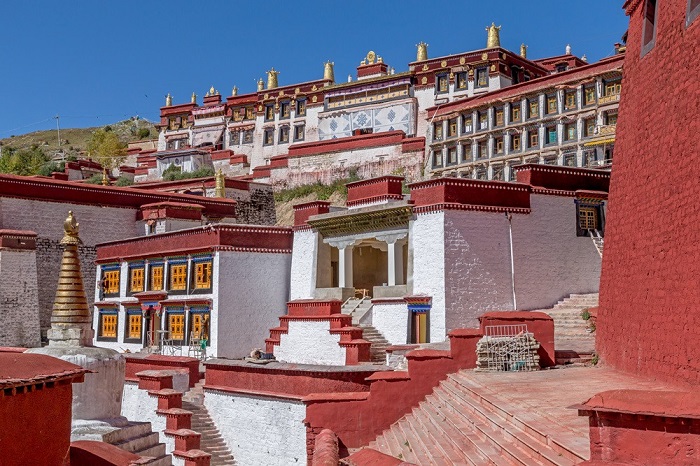
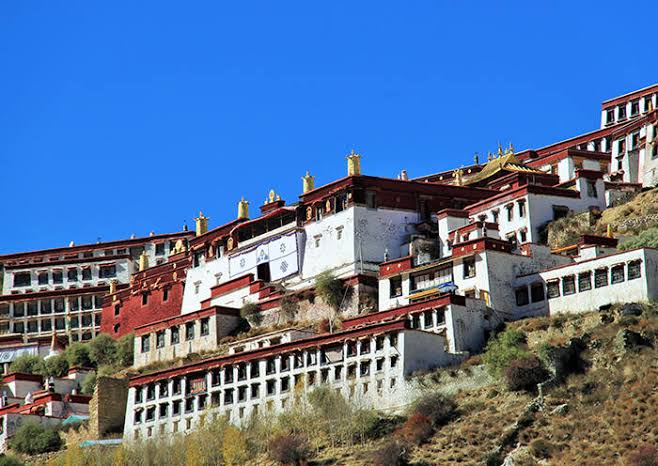
Ganden Monastery stands as a particularly striking example of Tibetan Buddhist architectural tradition, precisely because of how it interacts with its mountainous setting. Built directly into the steep slopes of Wangbur Mountain, the complex deliberately avoids the strict axial symmetry that characterizes many other major monasteries. Instead, the entire layout expands organically according to the natural contours of the terrain itself.
In the gentler, more level sections of the mountainside, builders constructed the monastery’s spacious assembly halls and main temples. On the steeper slopes surrounding these central structures, monks’ living quarters and various auxiliary buildings were arranged in a way that allows the entire complex to blend almost seamlessly into the surrounding mountain landscape, rather than imposing itself awkwardly on the terrain.
At the heart of the monastery sits the Tsokchen Assembly Hall, the central structure around which the rest of the complex is organized. Surrounding it are scripture halls, smaller temples, sacred stupas, and the two main monastic colleges, known as dratsangs, together forming a remarkably complete and well-organized religious complex. Among these various structures, Tsoktokhang, sometimes also rendered as Tsotruk Kang, stands out for being built directly against a cliff face, making it one of the most visually distinctive and architecturally daring structures found anywhere within Ganden Monastery.
Main Highlights Worth Exploring at Ganden Monastery
Tsokchen Assembly Hall
The Tsokchen Assembly Hall ranks as the single most important building within the entire monastery complex, serving as the primary venue for major religious ceremonies and the daily chanting rituals that anchor monastic life here.
Inside this central hall, visitors will find statues depicting Maitreya Buddha, Je Tsongkhapa himself, and several other significant deities, alongside an extensive collection of precious religious relics. One particularly notable feature is an elaborately crafted throne supported by five golden lions, said to have been specifically prepared for Je Tsongkhapa following the establishment of the Gelug tradition. The hall also carefully preserves Tsongkhapa’s own meditation bed, along with a complete set of the Kangyur and Tengyur scriptures, the foundational canonical texts of Tibetan Buddhism, written entirely in pure gold and officially classified as national-level cultural relics. Many of the ritual objects, offerings, and decorative elements found throughout the hall are believed to date back to the Ming dynasty, joined by numerous ancient murals, intricate thangka paintings, and traditional ritual instruments that fill the space.
One particularly famous detail within the hall is a suspended wooden pillar, with a visible gap left intentionally between its base and the floor below. This unusual architectural feature draws pilgrims who travel specifically to reach out and touch it, believing the gesture brings spiritual blessings.
Tsoktokhang
Tsoktokhang once served as both the personal residence and meditation chamber of Je Tsongkhapa himself, later becoming an important retreat site for the successive generations of Ganden Tripas who followed him. The temple also houses tantric mandalas used specifically within Gelug religious practice, alongside ceremonial robes, meditation cushions, official seals, and other sacred objects once used by Tsongkhapa and the Ganden Tripas who came after him.
In addition to these historical treasures, the hall enshrines statues of Manjushri and several other deeply revered Buddhist deities. Given its layered history and continued religious use, Tsoktokhang is widely considered one of the most historically and religiously significant structures found anywhere within Ganden Monastery.
Serdong Hall, also known as the Stupa Hall
Serdong Hall, frequently referred to simply as the Stupa Hall, serves as the sacred resting place where the stupa containing Je Tsongkhapa’s remains is enshrined.
Following Tsongkhapa’s death in 1419, his grieving disciples constructed a stupa specifically to hold and honor his remains. The original structure was crafted from approximately 900 taels of silver. Years later, the 13th Dalai Lama had the entire stupa covered in gold and further adorned with precious inlaid jewels, transforming it into the resplendent monument visitors encounter today. Since that renovation, successive Ganden Tripas have similarly been commemorated with their own stupas built within the monastery grounds. Today, the hall contains a remarkable total of 95 individual stupas, representing an unbroken lineage of spiritual leadership spanning centuries.
Walking the Ganden Kora Pilgrimage Trail
The Ganden Kora ranks among the most distinctive pilgrimage routes found anywhere at Ganden Monastery, and it represents one of the primary reasons so many visitors make the journey here in the first place. The full loop covers approximately 3 kilometers and typically takes between 1 and 2 hours to complete on foot at a comfortable pace.
When compared directly with Drepung Monastery and Sera Monastery, one of Ganden’s greatest draws extends well beyond its historical and religious significance alone. This ridge-top pilgrimage trail offers something genuinely unique: a single experience where monastery architecture, dramatic high-altitude landscapes, and authentic Buddhist devotional practice all converge simultaneously along the same path.
Along the route, the trail winds past numerous stupas, mani stones inscribed with sacred mantras, fluttering prayer flags, and several other sacred sites scattered along the way. For devout pilgrims, walking this path represents an important opportunity for accumulating spiritual merit. For curious visitors, meanwhile, it offers a genuinely meaningful way to better understand Tibetan Buddhist culture and the local spiritual traditions that continue to shape daily life here.
The trail also passes several scenic viewpoints situated behind the main monastery complex, each offering sweeping, wide-open vistas across the surrounding valleys and the broader Tibetan plateau beyond.
For visitors working with a more limited travel schedule, a visit to Ganden Monastery that includes the main section of the kora can typically be completed within 2 to 3 hours. Those hoping to complete the entire circuit in full should plan to allocate roughly half a day for the experience.
Because the monastery sits directly along a mountain ridge, the kora route itself is not completely flat. Certain sections involve noticeable ascents, descents, and uneven stone steps along the way. For most reasonably fit travelers, the overall walk falls into a moderate difficulty range. That said, given the significant altitude involved, it remains wise to walk at a slower pace throughout and take regular breaks as needed, rather than rushing through the experience.
Ganden Monastery
How to Get to Ganden Monastery
Ganden Monastery sits on Wangbur Mountain within Dagze District, located roughly 40 kilometers from central Lhasa. Given its somewhat remote, mountainous location, many travelers choose to pair a visit here with a day trip to the nearby Drak Yerpa Hermitage, creating a more complete and efficient itinerary that maximizes the long drive out from the city.
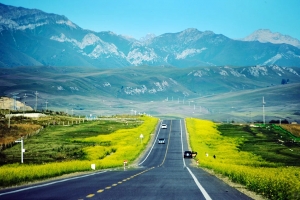
The drive out from Lhasa typically takes somewhere between 1.5 and 2 hours. Along the way, the surrounding scenery gradually transitions from urban cityscape into rural river valleys, before finally climbing into dramatic high-altitude mountain terrain, offering travelers a genuinely varied and visually rewarding journey. While road conditions are generally good throughout, actual travel time can shift somewhat depending on prevailing weather conditions on any given day.
It is worth noting that foreign visitors are typically required to travel with a licensed guide and pre-arranged transportation booked through an authorized travel agency such as TibetYulong Travel, in keeping with standard regulations governing foreign travel throughout the Tibet Autonomous Region.
The Best Time to Visit Ganden Monastery
The ideal window for visiting Ganden Monastery runs from May through October, a period when weather conditions tend to remain relatively stable and overall conditions prove genuinely ideal for sightseeing and photographing the dramatic highland landscapes surrounding the monastery.
For travelers specifically interested in experiencing a traditional religious festival during their visit, the Butter Lamp Festival, held on the 25th day of the 10th month according to the Tibetan lunar calendar, deserves particular attention and consideration when planning travel dates.
The Butter Lamp Festival
The Butter Lamp Festival stands as an important annual religious event held in solemn memory of Je Tsongkhapa’s passing, and it ranks among the most significant ceremonies observed throughout the year at Ganden Monastery.
During the festival itself, thousands of butter lamps are lit throughout the entire monastery complex, while monks and devoted pilgrims gather together to hold extended prayer ceremonies marking the occasion. As night gradually falls across the mountain, the entire monastery becomes illuminated by countless flickering lights, creating a genuinely solemn yet spectacular visual scene that draws numerous pilgrims and curious visitors alike to witness it firsthand each year.
Nearby Attractions Worth Combining With a Ganden Monastery Visit
Given Ganden’s location within reasonable driving distance of central Lhasa, many travelers choose to combine a visit here with several other significant cultural and religious sites found throughout the broader Lhasa region.
Sera Monastery and Drepung Monastery, the other two of the three great Gelug monasteries in Lhasa, offer a natural point of comparison and a deeper understanding of how the tradition Je Tsongkhapa founded ultimately expanded across the region. The Potala Palace, the historic former residence of the Dalai Lamas, and Jokhang Temple, widely considered the spiritual heart of Tibetan Buddhism, both rank among the most essential stops for any traveler exploring Lhasa’s cultural heritage.
Beyond these headline sites, Ramoche Temple and Drolma Lhakhang Monastery offer additional layers of religious and historical depth for travelers with extra time to spare. The Tibet Museum provides valuable broader context for understanding the artifacts, artwork, and traditions encountered throughout the region’s monasteries. For those willing to venture slightly further afield, Nalendra Monastery offers yet another meaningful stop connected to Tibet’s rich monastic history.
Planning a Meaningful Visit to Ganden Monastery
Ganden Monastery offers travelers something genuinely distinctive within the broader landscape of Lhasa’s religious sites: a direct, tangible connection to the founding moment of the Gelug tradition itself, paired with one of the most rewarding pilgrimage walks found anywhere on the Tibetan plateau. Between the historical weight of the Tsokchen Assembly Hall, the quiet intimacy of Tsoktokhang, the layered history contained within the 95 stupas of Serdong Hall, and the sweeping mountain views encountered along the Ganden Kora, this single monastery offers an unusually complete picture of what makes Tibetan Buddhist culture so enduring.
Travelers should also keep in mind that, because of the altitude involved along both the drive and the kora trail itself, a visit to Ganden Monastery is best approached after a few days of acclimatization in Lhasa rather than as the very first stop on a Tibet itinerary. Arriving with a body that has already adjusted somewhat to the thinner air makes the walk around the kora considerably more enjoyable, leaving more attention free to appreciate the scenery and the spiritual atmosphere rather than simply catching your breath.
Given the permit requirements and guided travel regulations that apply to foreign visitors throughout the Tibet Autonomous Region, working with an experienced local operator such as TibetYulong Travel can make planning a visit considerably more straightforward. A knowledgeable local team can help arrange the necessary documentation, coordinate transportation along the mountain road from Lhasa, and design an itinerary that pairs Ganden Monastery with nearby sites like Drak Yerpa Hermitage or the other great Gelug monasteries, ensuring your time exploring this remarkable Sky Monastery is both smooth and genuinely memorable. Whether you arrive during the clear skies of the spring and autumn travel season or time your visit to coincide with the dramatic glow of the Butter Lamp Festival, Ganden Monastery offers a rare opportunity to stand at the literal birthplace of one of Tibetan Buddhism’s most influential traditions, surrounded by some of the most striking mountain scenery the plateau has to offer.