At 3,650 meters above sea level, Lhasa sits higher than almost any other capital city on earth. It is the political, religious, and cultural heart of Tibet – a place where whitewashed monastery walls reflect the intense Himalayan sun, where pilgrims spin prayer wheels along stone-paved streets worn smooth by centuries of devotion, and where some of the most architecturally stunning sacred sites in Asia have stood largely undisturbed for over a thousand years.
For international travelers, Lhasa is almost always the starting point for any Tibet journey. It is where permits are processed, where bodies begin adjusting to altitude, and where the sheer scale of Tibetan culture first becomes real. Whether you are planning a short city-focused itinerary or using Lhasa as a launchpad for Everest Base Camp or Mount Kailash, understanding the city before you arrive makes a significant difference to your experience.
This guide covers the key things every international traveler needs to know: the top attractions, how to get there, what the weather is like, where to stay and eat, and the practical logistics that are unique to visiting Lhasa.
Top Attractions in Lhasa
Lhasa’s mild climate and relatively stable conditions over centuries have helped preserve an extraordinary concentration of cultural and religious heritage. The city’s landmark sites are genuinely world-class – not in the polished, tourist-infrastructure sense, but in the sense that they have shaped the spiritual and political history of an entire civilization.
Potala Palace
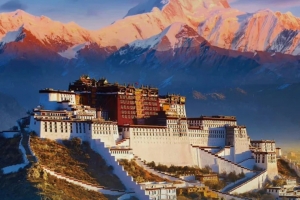
No single structure defines Lhasa more completely than the Potala Palace. Rising dramatically from Red Hill in the center of the city, this thirteen-story, thousand-room complex was once the winter residence of the Dalai Lama and the administrative seat of Tibetan government. Construction of the current structure began in the 17th century under the Fifth Dalai Lama, though the site itself has held religious significance for far longer.
The palace contains an extraordinary collection of sacred art, including thousands of murals, statues, and gilded stupas housing the remains of previous Dalai Lamas. Visitor numbers are strictly controlled each day, and tickets must be secured well in advance – this is not a site you can simply turn up at and walk into. The views of Lhasa from the upper levels, with the Kyichu River valley spread out below and mountains rising in every direction, are unlike anything else in the city.
Jokhang Temple
If the Potala Palace is Lhasa’s most visually commanding landmark, Jokhang Temple is its spiritual epicenter. Built in the 7th century during the reign of King Songtsen Gampo, this temple is considered the holiest site in Tibetan Buddhism. The Jowo Shakyamuni statue housed within – a depiction of the Buddha as a young man, brought to Tibet as part of a royal marriage alliance – draws pilgrims from across the Tibetan world who travel enormous distances specifically to prostrate before it.
The atmosphere around Jokhang is unlike anywhere else in Tibet. Throughout the day and into the evening, pilgrims circumambulate the temple along the Barkhor circuit, a circular street that functions simultaneously as a sacred kora route and a vibrant market. The smell of burning juniper, the sound of murmured mantras, and the sight of full-body prostrations performed on the stone pavement outside the temple entrance create an atmosphere that stays with visitors long after they leave.
Norbulingka
A short distance west of the Potala Palace, Norbulingka served as the summer palace of the Dalai Lamas from the 18th century onward. In contrast to the imposing architecture of the Potala, Norbulingka is defined by its extensive gardens – a rare expanse of greenery in the heart of the city that Lhasa residents still use as a park and picnic ground.
The complex contains several ornate palace buildings with well-preserved interiors, including the New Summer Palace completed in 1956, which offers an intimate look at how the Dalai Lama’s private quarters were arranged. During the Shoton Festival, held each summer, Norbulingka becomes the venue for open-air Tibetan opera performances that draw enormous crowds of local families.
Ganden Monastery
Located about 45 kilometers east of Lhasa on a ridge above the Kyichu River valley, Ganden Monastery is the founding monastery of the Gelug school of Tibetan Buddhism – the school to which the Dalai Lama belongs. Originally established in the early 15th century by Je Tsongkhapa, Ganden was largely destroyed during the Cultural Revolution and has been painstakingly rebuilt by the monastic community over the past few decades.
The setting alone makes the journey worthwhile. The monastery clings to a high ridgeline at roughly 4,300 meters, and the kora path that circles the complex offers sweeping views across the valley below. It sees far fewer foreign visitors than the city-center sites, which gives it a more quietly authentic atmosphere.
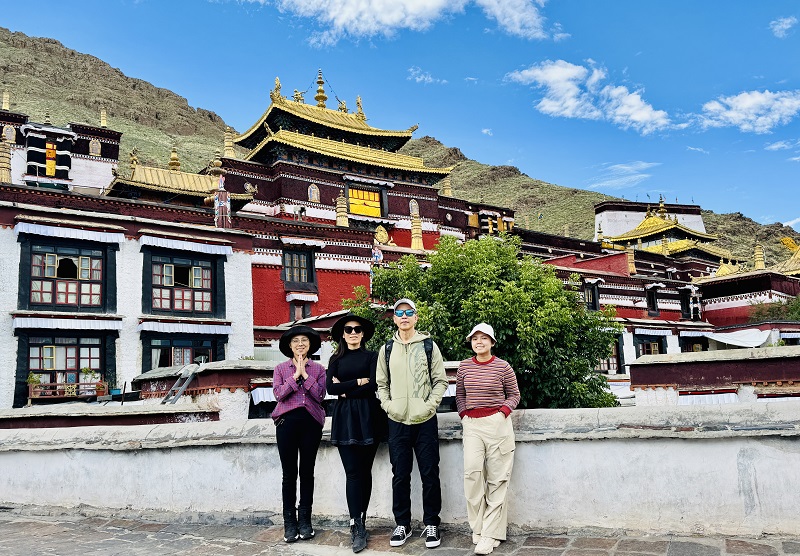
Jokhang Temple Visitors
How to Get to Lhasa
As Tibet’s capital and primary entry point, Lhasa is reasonably well-connected to the rest of China – though all access routes for international tourists require advance planning and permit arrangements.
Flying to Lhasa
Lhasa Gonggar International Airport sits 62 kilometers south of the city center and is the busiest airport in Tibet. It handles a significant volume of domestic air traffic, with direct routes connecting Lhasa to Beijing, Shanghai, Guangzhou, Chengdu, Chongqing, Kunming, Xi’an, Xining, Lanzhou, Lijiang, and Shangri-La, among other cities. Frequency on popular routes – particularly from Chengdu – can be several times daily during peak season.
For international travelers, there is also a direct air connection between Lhasa and Kathmandu, Nepal, which is particularly useful for those combining a Tibet tour with time in Nepal or approaching Tibet via the Gyirong land border route in reverse.
Flying is the fastest way to reach Lhasa, but the rapid gain in altitude – particularly if you are flying from a low-elevation city like Shanghai or Guangzhou – means your body has very little time to adjust before arriving at 3,650 meters. This makes the first day or two in Lhasa particularly important for rest and acclimatization.
Taking the Train to Lhasa
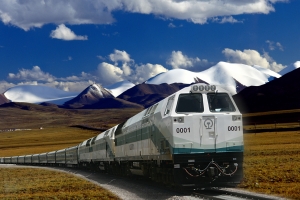
The Qinghai-Tibet Railway remains one of the great engineering achievements of the modern era, and the journey to Lhasa by train is a genuinely remarkable experience in its own right. The line crosses some of the highest and most remote terrain on earth, including a stretch above 5,000 meters on the Tibetan plateau, with panoramic views of grasslands, lakes, and mountains that no road or flight can match.
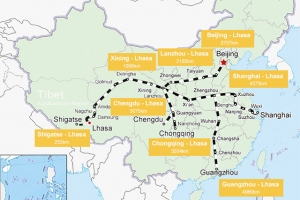
Direct train services to Lhasa operate from Beijing, Shanghai, Guangzhou, Chengdu, Chongqing, Xining, and Lanzhou. Journey times vary considerably – from around 21 hours from Xining to 40+ hours from Beijing or Shanghai – but the slower pace has a genuine advantage: it gives your body time to acclimatize gradually as the train climbs in elevation, which significantly reduces the severity of altitude sickness for many travelers.
All Tibet-bound trains are equipped with oxygen supply systems, and the scenery through the carriage windows in the final stretch across the plateau is something many travelers count among the highlights of their entire trip.
Lhasa Weather and Best Time to Visit
Lhasa averages around 3,000 hours of sunshine per year, earning it a well-deserved reputation as the Sunshine City. Its position on the high plateau creates a distinctive climate: strong solar radiation, long clear days, low humidity, and significant temperature swings between midday and midnight that can easily exceed 15 degrees Celsius in a single day.
Precipitation is concentrated between June and September, when the Indian monsoon pushes moisture northward onto the plateau. Rain in Lhasa during this period tends to fall in shorter bursts rather than all-day downpours, and it does not typically prevent sightseeing.
The best time to visit Lhasa is generally considered to be between April and October. During these months, temperatures are warmer, days are longer, and the landscape around the city – and on routes leading to Everest and Kailash – is at its most accessible. Travelers visiting in July and August should be aware that this is peak season, which means higher hotel prices, more crowded attractions, and the need to book permits and accommodation well in advance.
Winter visits between November and March are possible and increasingly popular with travelers who prefer quieter sites and lower prices, but temperatures can drop sharply at night, and some high-altitude routes outside the city may be restricted or impassable.
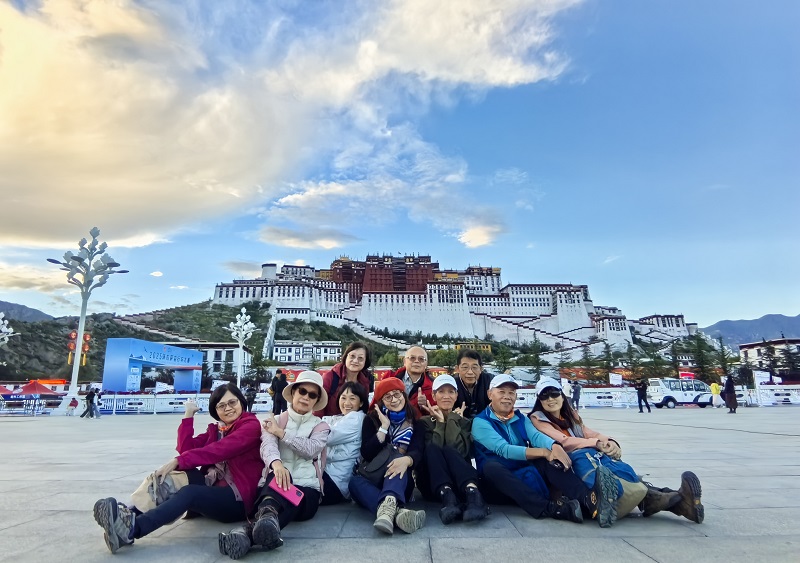
Potala Palace Visitors
Where to Stay in Lhasa
Lhasa offers a genuinely wide range of accommodation, from international five-star hotel brands to Tibetan guesthouses that provide a far more local experience at a fraction of the price.
At the top end, properties like the St. Regis Lhasa Resort and the Shangri-La Lhasa Hotel offer the facilities and service standards international luxury travelers expect, combined with Tibetan architectural design elements that make them feel distinct from equivalent properties in other Chinese cities. It is worth noting that even high-rated hotels in Lhasa may not fully match the standards of equivalent properties in major cities like Beijing or Shanghai – but many travelers find that the Tibetan aesthetic and cultural touches more than compensate.
For mid-range and budget travelers, the area around Barkhor Street offers the most rewarding location. Staying close to the old city puts you within easy walking distance of Jokhang Temple, the Barkhor circuit, and the narrow lanes of traditional Lhasa that most visitors find to be the most atmospheric part of the city. Many guesthouses in this area are family-run and offer genuine warmth and local character that larger hotels cannot replicate.
Food and Dining in Lhasa
Lhasa has by far the most developed dining scene in Tibet, and the range of options available to international travelers goes well beyond traditional Tibetan cuisine.
The local food worth trying includes Tibetan noodles – a simple, hearty dish eaten across the plateau – sweet butter tea, which is an acquired taste but deeply embedded in Tibetan culture, dried yak beef and mutton, and Lhasa Beer, a light local brew that pairs surprisingly well with both Tibetan and Sichuan dishes.
Sichuan-style cooking is widely available throughout the city and tends to be reliably good, reflecting the large number of Sichuan migrants who have settled in Lhasa. Nepalese and Indian restaurants also operate in the city, offering vegetarian-friendly menus that some travelers find a welcome change.
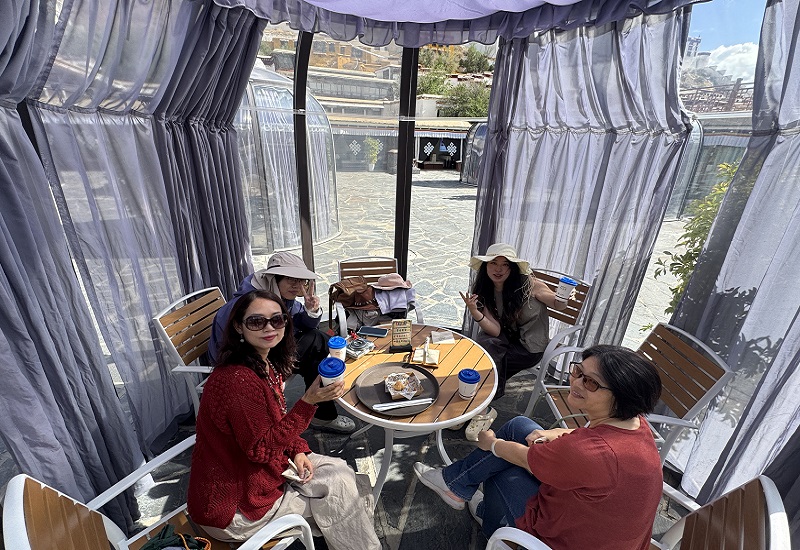
Along Beijing Road, the main commercial artery of modern Lhasa, a cluster of Western-oriented restaurants caters to international visitors – offering everything from pizza to sandwiches to continental breakfast menus. Quality and consistency vary, but options exist for travelers who find the transition to local food difficult in the first few days.
Lhasa Afternoon Tea
Essential Travel Tips for Visiting Lhasa
Tibet Travel Permit – a non-negotiable requirement
International travelers cannot enter Lhasa – or anywhere else in Tibet – without a Tibet Travel Permit issued by the Tibet Tourism Bureau. This permit cannot be applied for independently; it must be arranged through a licensed Tibet travel agency. Without it, you will not be permitted to board a domestic flight or train to Lhasa, regardless of your other travel documents.
The permit application requires your passport details and must be submitted in advance of your travel dates. When you book a Tibet tour through Journey2tibet, the permit application is handled entirely on your behalf, and you will receive your permit before your journey begins.
Managing Altitude in Lhasa
At 3,650 meters, Lhasa sits high enough that the majority of first-time visitors experience some degree of altitude adjustment on arrival. Symptoms range from mild headaches and fatigue to more pronounced dizziness and shortness of breath, and they typically peak within the first 24 to 48 hours before gradually easing.
The most effective way to manage altitude in Lhasa is straightforward: rest on your first day, drink plenty of water, avoid alcohol and strenuous physical activity, and do not shower immediately upon arrival if you can help it. Most travelers feel significantly better by the second or third day, and the body continues to adapt over the following week.
If you are flying to Lhasa from a low-altitude city, consider planning a lighter first day with no major sightseeing. The Potala Palace, with its steep staircase climb, is best left until day two or three when your body has had time to settle.
Plan Your Lhasa Trip With Journey2tibet
Lhasa rewards travelers who arrive prepared. The permit requirements, the altitude, the limited window for booking popular sites like the Potala Palace – these are all manageable, but they require advance planning that is different from most other destinations.
Journey2tibet specializes in helping international travelers navigate every step of the process, from permit applications and itinerary design to on-the-ground support from experienced local Tibetan guides throughout your stay. Whether you are planning a short Lhasa city tour or using the city as the starting point for a longer journey across the plateau, our team is ready to help you build the trip that fits your timeline, budget, and interests.
Reach out to Journey2tibet today to start planning your Lhasa adventure.