There is no place on the landmass of Earth that makes humankind feel more beautifully minuscule than the Himalayas, and no single mountain peak captures the soul of global travelers quite like Mount Everest, towering at a staggering 8,848.86 meters. Situated within Tingri County in Shigatse, Tibet, Everest Base Camp (EBC) sits at an altitude of 5,200 meters inside a dramatic glacial valley. It represents the ultimate frontier where ordinary travelers—without the years of grueling professional mountaineering training—can arrive via vehicle to gaze upon the highest point of our planet with their own eyes. EBC is far more than a mere geographical coordinate displaying tectonic majesty; it is a profound sanctuary that tests physical endurance and cleanses the spirit. When you finally stand before the iconic “Mount Everest Height Measurement Monument” after hundreds of kilometers of rugged mountain roads, watching that colossal, pyramid-shaped fortress of ice and snow loom unobstructed across the horizon, the sheer weight of its presence delivers a wave of realization that stays with you for a lifetime.
The Everest Highway & The Majestic Gawula Pass
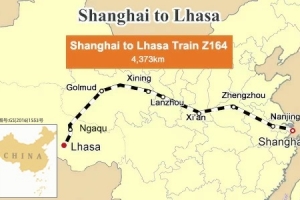
To witness the crown of the world, travelers must first conquer a masterpiece of civil engineering: the winding Everest Highway (Self-Drive Route). This pilgrimage typically begins in the holy city of Lhasa, traveling westward along National Highway 318—voted “China’s Most Beautiful Landscape Avenue”—passing through the historic hub of Shigatse before turning onto the dedicated Everest access road. The most jaw-dropping visual wonder along this entire route is the dramatic traverse over Gawula Pass. Renowned globally as one of the most spectacular mountain passes on Earth, it features an extreme mountain descent made of 108 tight hairpin turns, looking from above like a giant dragon coiling around the barren Karst mountainside. Even more breathtaking is the panorama from the 5,210-meter-high viewing platform at Gawula Pass. On a clear day, travelers can look across the horizon and simultaneously witness five peaks towering over 8,000 meters: Makalu, Lhotse, Everest, Cho Oyu, and Shishapangma. This staggering white arc forms Earth’s grandest “8,000-meter mountain symphony,” acting as a deeply dramatic prelude before you even enter the base camp itself.
Rongbuk Monastery: Where Faith Meets the Summit
Upon arriving at the 5,200-meter core area of Base Camp, visitors are greeted by Rongbuk Monastery. Founded in the early 20th century, this ancient sanctuary holds the title of the highest monastery in the world, uniquely housing both monks and nuns under the shadow of the great peak. The architectural brilliance of Rongbuk Monastery lies in its perfect spatial harmony with Mount Everest—when looking past the ancient white stupa of the temple, the summit of Everest aligns flawlessly right in the center of the valley walls. This sacred white stupa set against the snow-covered giant under a brilliant, high-altitude blue sky creates the most iconic photographic image of Tibet. The gentle drift of juniper smoke and the low, resonant chanting of resident lamas add a layer of profound human faith to the otherwise freezing, extreme wilderness. Nearby, at the official milestone monument, travelers from every corner of the globe eagerly photograph themselves alongside the “5,200m” stone inscription, a physical declaration of a major life milestone achieved.
Extreme Weather & The Best Seasons to Explore
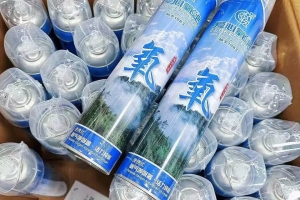
Living on the edge of heaven requires adjusting to the region’s notoriously Extreme Weather Conditions. Perched in a high-alpine zone, the air at Everest Base Camp holds only about half the oxygen found at sea level, and the landscape is defined by howling, relentless winds and dramatic temperature drops between day and night. Even during the peak of summer in July and August, nighttime temperatures routinely plummet below freezing, with mountain winds that cut straight to the bone. The beauty of Everest shifts beautifully with the seasons: April to May and September to October are widely considered the golden windows for exploration. These months mark the dry season on the plateau, offering crisp, cloudless skies that provide an incredibly high probability of witnessing the full peak, the legendary “Golden Peak” at sunset, and the brilliant, dense canopy of the Everest Starry Sky. Conversely, the summer monsoon season from June to August brings milder temperatures but often keeps the summit shyly hidden behind rolling mists and heavy clouds. Consequently, heavy windproof down jackets, fleece layers, UV protection, and thorough preparation for acute mountain sickness (AMS) are mandatory gear for every traveler.
Accommodation at EBC: Nomad Tents & Oxygenated Hotels
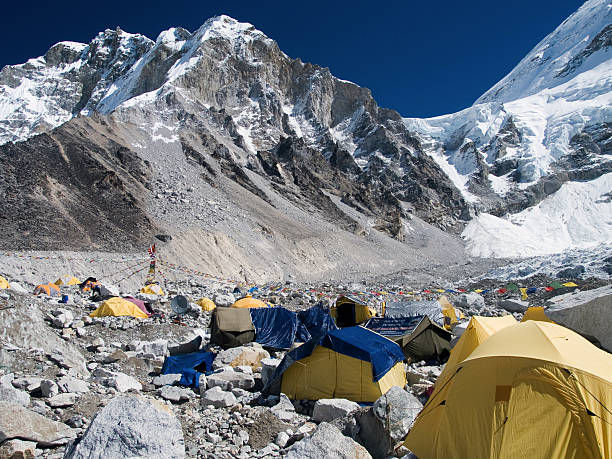
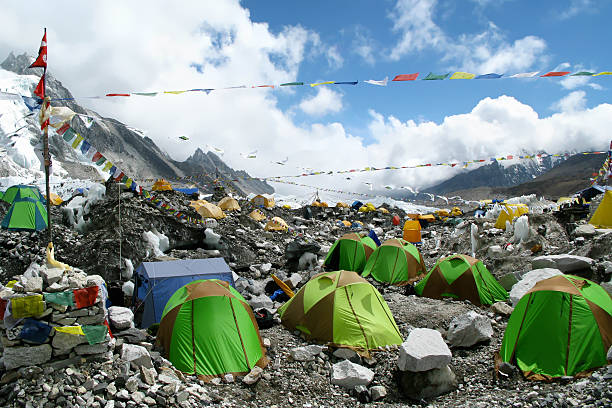
When it comes to the Accommodation Experience at the top of the world, recent infrastructure upgrades mean travelers no longer have to completely sacrifice comfort for adventure. During the peak travel season (April to October), the core area of Base Camp features rows of traditional black yak-hair Nomad Tent Hostels run by local Tibetan families. Staying inside these tents is admittedly simple, utilizing shared communal eco-facilities, but it offers a profoundly authentic experience. You can gather around a warm stove fueled by dried yak dung, sip steaming bowls of Tibetan butter tea, and step just outside your tent flap at midnight to find yourself immersed directly under the Milky Way arching over Everest. For those visiting during the freezing winter-spring months, or for travelers with premium comfort and altitude-management requirements, we highly recommend staying in Tingri Zhaxizong Village or Baiba Town, located about an hour’s drive from the camp. These areas feature modern hotels equipped with diffuse oxygenation systems in the rooms, successfully alleviating high-altitude headaches and insomnia to ensure a restful night.
Executing a flawless expedition to Everest requires highly meticulous and professional operational support. Because Everest Base Camp sits directly along the sensitive border frontier between China and Nepal, all international travelers and domestic tourists must secure a Border Travel Permit (Border Pass) in advance through Lhasa or Shigatse, while strictly adhering to local ecological protection laws. To safeguard this fragile glacial environment, private fossil-fuel vehicles are completely restricted from entering the core camp area; all guests must switch to clean-energy eco-shuttle buses at Zhaxizong Village. As an expert team deeply rooted across the Tibetan plateau, we advise our clients to follow a stepped altitude acclimatization plan, spending a few days exploring Lhasa (3,650m) and Shigatse (3,800m) before ascending to Everest, avoiding a direct leap from low valleys to prevent severe altitude sickness.
Mount Everest Base Camp is the ultimate destination where the raw, unyielding power of nature meets the timeless spirit of human exploration. Through millions of years of glacial patience, it has built an untouchable white throne upon the roof of the world. As your long journey of bumps and turns concludes, sitting inside a warm tent and watching the final ray of golden sunlight turn the iconic flag cloud atop Everest into a brilliant rose gold, the only sound left is the whisper of the high-altitude wind. You realize that this grueling journey along the “Sky Road” is far more than a visual pilgrimage to the highest peak on Earth—it is a spiritual journey that pushes your personal boundaries, leaving you face-to-face with your truest self in the pure, thin air.