For every traveler yearning for the “Roof of the World,” the journey itself is as sacred as the destination. Among the many celestial roads leading to Tibet, the Sichuan-Tibet Line (G318) and the Qinghai-Tibet Line (G109) are undoubtedly the most iconic. They are like two distinct ribbons: one winds through the deep folds of the Hengduan Mountains, weaving dreams of forests and glaciers; the other stretches across a desolate plateau at an average elevation of over 4,500 meters, bearing witness to the dignity of solitude and life.
The Visual Feast of the Sichuan-Tibet Line: Alpine Elegance and Thrills
The Sichuan-Tibet Line is often hailed as “China’s most scenic landscape avenue,” a title it earns with every kilometer. Starting from Chengdu, as the altitude gradually climbs, you experience a visual magic show transitioning from humid subtropical forests to high-altitude alpine tundras. The most captivating feature of this route is its “wave-like” altitude profile. While you must cross over a dozen mountain passes exceeding 4,000 meters, the road frequently descends into lush valleys like Nyingchi or Bomi (around 2,000 meters) for overnight stays. This significantly alleviates the pressure of altitude sickness, allowing the body to recover in oxygen-rich environments.
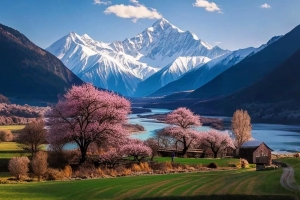
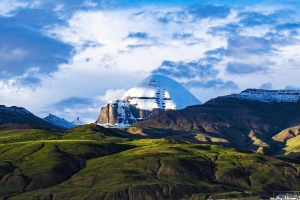
If you embark on this journey during March or April, Nyingchi will reveal the gentlest side of Tibet. While the distant peaks remain capped in eternal snow, the wild peach blossoms at their base bloom like pink clouds. This striking contrast between the cold summits and the warm blossoms is a natural masterpiece that no camera filter can truly replicate. Further along, Ranwu Lake welcomes you with its mirror-still waters. Nearby, the Midui Glacier—one of the lowest-altitude glaciers in the world—pokes its crystalline blue tongue out from the dense green forest, creating an exquisite scene of geological harmony.
However, the beauty of the Sichuan-Tibet Line is accompanied by heart-pounding challenges. The famous “72 Curves of the Nu River” is a test for every driver. Countless hairpin turns spiral down the mountain, testing not only the braking system but also the driver’s psychological resilience when facing deep canyons. During the rainy season, the unstable geological structure makes landslides a potential risk, adding a layer of profound respect for the raw power of nature.
The Grandeur of the Qinghai-Tibet Line: Solitude and Celestial Vistas
In contrast to the intricate variety of the Sichuan-Tibet route, the Qinghai-Tibet Line is expansive and solemn. Starting from Xining, most of the road resembles a black steel dragon cutting through a boundless wilderness. Here, there are no dense forests; instead, you are greeted by the continuous Kunlun Mountains and the vast, untouched Kekexili (Hoh Xil).
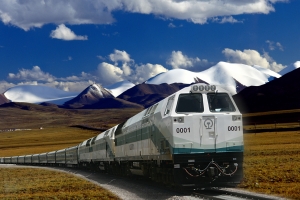
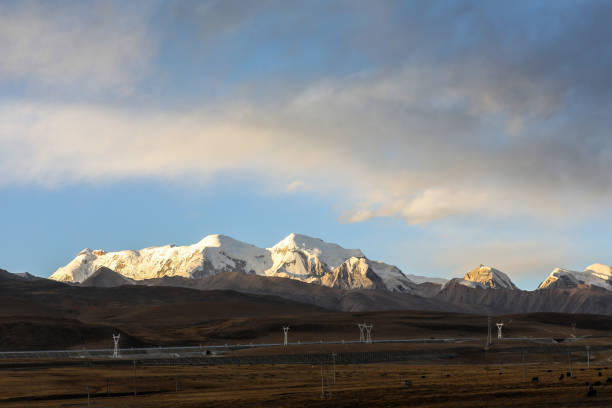
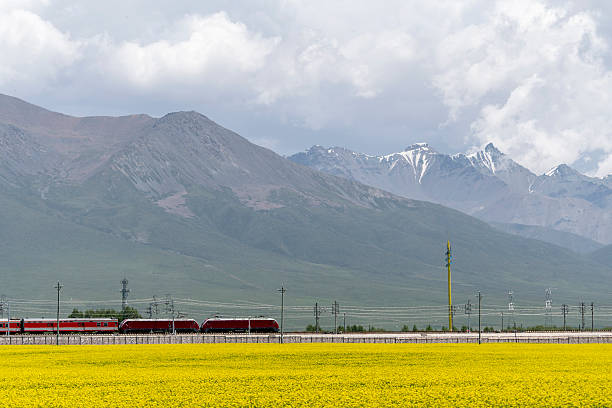
Crossing the Kekexili No-Man’s Land is a spiritual experience. Along this stretch, the Qinghai-Tibet Railway often runs parallel to the highway. The sight of a train racing across the highland meadows, kicking up dust against a backdrop of grazing Tibetan antelopes and wild donkeys, creates a unique portrait of harmony. While the road is straighter and flatter, it hides its own dangers. The permafrost layers beneath the asphalt can cause the road to buckle or dip, creating “undulating waves.” Driving at high speeds over these dips can cause a vehicle to lose control, requiring absolute focus and steady hands from the driver.
As you approach Lhasa, Lake Namtso stands as an unmissable sanctuary for the soul. As one of the three holy lakes of Tibet, its surface at 4,700 meters displays a deep, sacred blue, framed by the snow-clad Nyainqentanglha Mountains. Watching a sunset there, you will understand why this land is called the place closest to heaven.
“Sichuan-In, Qinghai-Out”: The Golden Strategy for Self-Drivers
For most first-time travelers to Tibet, we strongly recommend the “Sichuan-In, Qinghai-Out” loop strategy.
This is not just for the complementary scenery, but for scientific reasons. Entering via the Sichuan route allows your body to adapt to the rising altitude incrementally as you move up and down the mountain passes, minimizing the discomfort of acute mountain sickness. By the time you have spent a few weeks in Tibet and your body is fully “highland-adapted,” taking the faster, high-altitude Qinghai route for the return journey is both efficient and safer.
On the return leg through the Qinghai-Tibet Line, passing through notoriously thin-air spots like Wudaoliang or Tuotuo River might be challenging, but for a seasoned traveler who has already acclimatized, these hardships become the most cherished badges of honor from the trip.
Premium Self-Drive Recommendations and Safety
For those seeking a high-quality experience, we recommend choosing a high-performance 4WD SUV. This provides the necessary clearance and power to handle unexpected road conditions. Additionally, equipping your vehicle with medical-grade oxygen concentrators and satellite communication tools ensures that while you enjoy the solitude of the wilderness, you remain protected by modern technology.
Whether you are drawn to the forests and glaciers of the Sichuan-Tibet Line or the vast, celestial horizons of the Qinghai-Tibet Line, this thousand-mile journey will become the ultimate footnote to your courage and freedom.